


As an enterprise solution, Shopify Plus offers a number of advantages over classic Shopify. The only question is, when is a company really “enterprise” enough to make the switch? Moving to the system too soon would not be advisable, as the extra features naturally come with a price increase, which we don't want to hide. However, it could be even worse if you change your system too late, as a lower degree of automation, higher transaction costs and other disadvantages of Shopify compared to Shopify Plus could potentially hinder your processes.
We would like to use this article to show you phases in the development of a company in which a switch to Shopify Plus may be worthwhile.
In this article, you will find out when switching to Shopify Plus is worthwhile. We explain what Shopify Plus is, what you get starting at $2,300 a month, and its advantages and disadvantages compared to standard Shopify. We also show what changed in 2026 (such as Functions instead of Scripts), what to keep in mind when migrating from Shopware or Magento, and how to get started with a checklist and the right agency partner.
Reading tip: What is actually the difference between Shopify and Shopify Plus? We answer these questions and more in our Shopify and Shopify Plus FAQ blog.
Table of contents
You need help with your project? Feel free to contact us and we will gladly help you out. Contact us
What is Shopify Plus?
Shopify Plus is Shopify's enterprise plan designed for businesses with high volume, multiple markets, or complex processes. It offers greater control over checkout, automation, and B2B than standard plans.
How much does Shopify Plus cost?
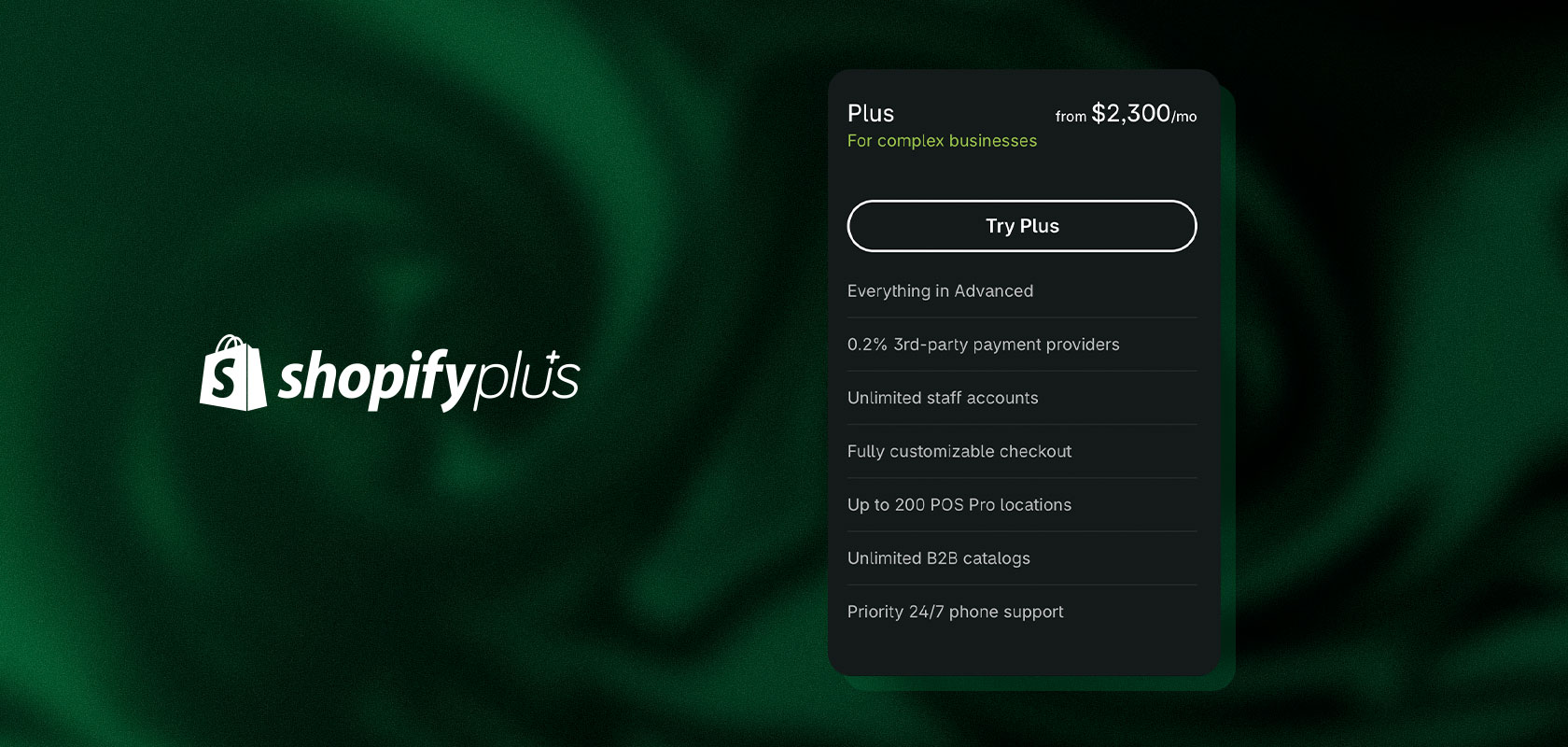
According to Shopify, Shopify Plus pricing starts at $2,300 per month on a three-year term or $2,500 per month on a one-year term. For Germany, agencies cite approximately €2,100 (3 years) or €2,250 (1 year) per month based on the Shopify pricing page; check the current daily rate directly with Shopify.
Quick Insight: What does Shopify Plus cost?
Starting at $2,300 per month on a three-year term, or $2,500 per month on a one-year term. At high volumes, a variable platform fee applies, which is determined via a custom quote. Apps and migration costs are additional.
For larger merchants, Shopify publishes neither the rate nor the threshold of the variable platform fee. Agencies frequently cite 0.35% (3 years) or 0.40% (1 year) of revenue starting at around $800,000 in monthly revenue, with a cap of $40,000 per month. You will find out the exact fee in your quote.
Added to this are apps, development, and the Shopify Plus migration itself. Their costs depend primarily on data volume (products, customers, order history), custom features and integrations (ERP, PIM, inventory management), design and checkout customization effort, as well as the number of markets.
Reading tip: An overview of all Shopify prices and Shopify plans can be found on this blog.
What are the advantages of Shopify Plus?
Shopify Plus customers benefit from several advantages over other systems. Shopify is a cloud-based system, for merchants this already means that system updates and backups happen automatically and there are no system changes to worry about. Other Shopify Plus benefits include:
Quick Insight: Do I need Plus for B2B or wholesale?
Not necessarily anymore. Since April 2, 2026, Shopify's B2B features have also been available on Basic, Grow, and Advanced plans, with up to three catalogs. Plus is worthwhile if you need unlimited catalogs, direct assignment to individual companies, and partial payments.

More stability and scalability: Up to 11,000 checkouts per minute - ideal for promotional days such as Black Friday
Customizable checkout: Customizations and logic via Checkout Extensibility and Shopify Functions, including advanced checkout branding
Up to 10 stores included: Ideal for internationalization, with own domains, currencies and content per market
Extended API access and higher API limits: Enables deeper integrations and better performance with large amounts of data
Shopify Flow: No-code automation of processes (e.g. VIP marking, email triggers) Launchpad: Planned sales promotions - with automated start, theme and price changes Exclusive apps such as Plus-ex Tools, B2B and B2B Shopify. e.g. VIP marking, stock alerts, email triggers)
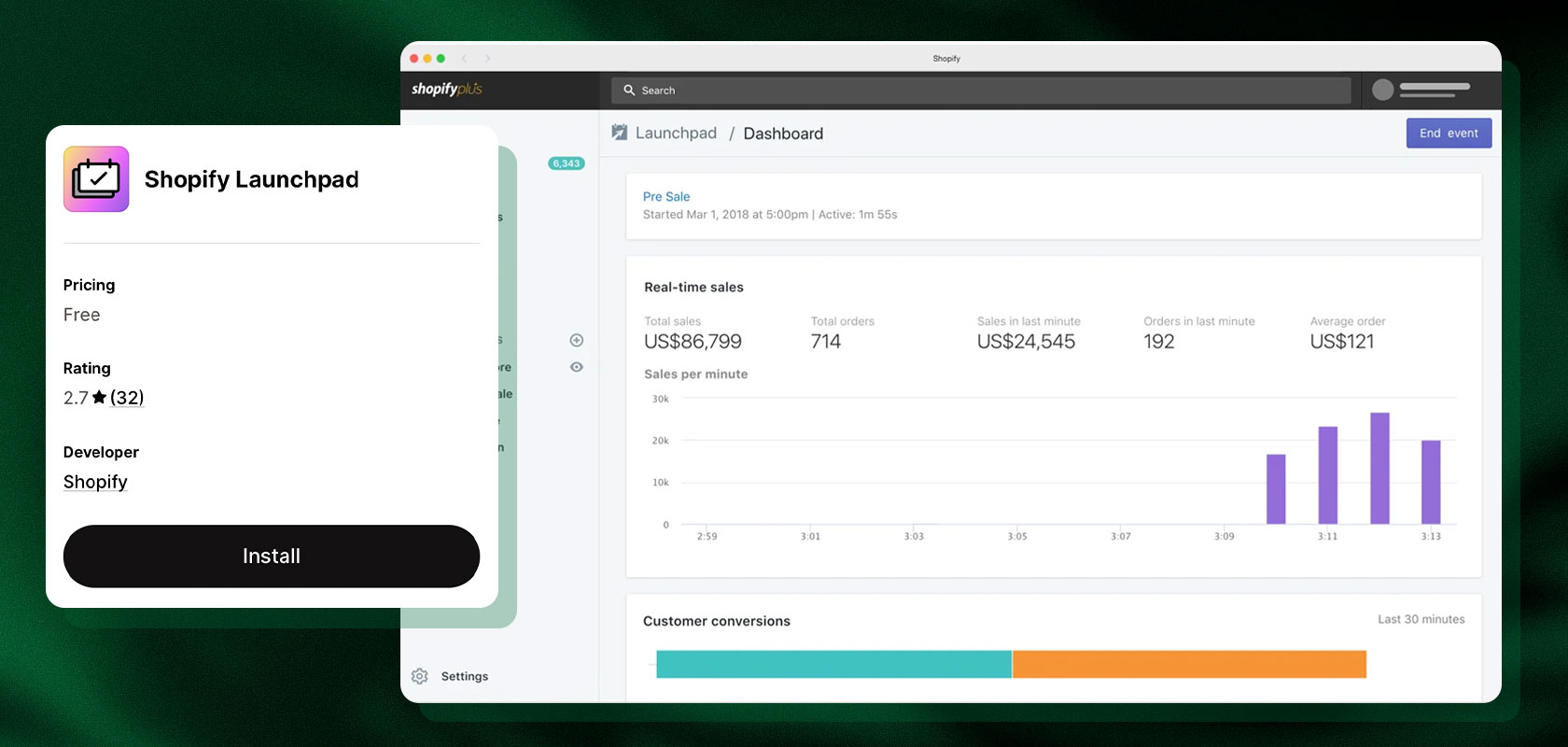
Launchpad: Plannable sales promotions - with automated launch, theme changes and price changes
Exclusive apps: Access to Plus-exclusive tools such as B2B, ShopifyQL Notebooks or Bulk Account Inviter
More user rights and roles: Granular authorization management for larger teams
Extended B2B functionality: integrated wholesale module with net prices, minimum order values, individual payment terms and much more.
Multilingual and multi-currency stores: Integrated via Shopify Markets, with customized checkout per market
Headless commerce options: Full flexibility for own frontends through Storefront API, Hydrogen/Remix or other headless approaches
Better performance with international traffic: Thanks to global CDN and server-side infrastructure
Shopify Disadvantages
When it comes to Shopify disadvantages, the native CMS should be mentioned. Especially for creating your own blog, this can be somewhat cumbersome. However, by implementing a headless CMS, such as Storyblok, a scalable and intuitive solution can be found here.
Quick Insight: What are the disadvantages of Shopify Plus?
Ongoing fixed costs with at least a 12-month term, less freedom in checkout compared to custom code, a limited CMS, and reliance on apps.
Additional disadvantages include the ongoing costs (Plus requires at least a 12-month term), less freedom in checkout compared to custom code, and reliance on apps.
Reading tip: We go into more detail about all the benefits of Shopify Plus here.
When is it worth switching to Shopify Plus?
When is your business big enough to make the move to the enterprise platform worthwhile?
That's a question many online retailers ask themselves. One metric that is often used in the decision-making process is revenue. But unfortunately, there's also no blanket answer to the question of what level of sales revenue makes Shopify Plus worthwhile. A sample calculation shows why revenue alone rarely decides the issue: according to the Shopify pricing page, Plus starts at €2,100 per month, or around €25,200 per year. For third-party payment providers, Shopify charges 0.2% on Plus and 0.6% on Advanced (Swiss pricing page, varies by region). The 0.4 percentage point savings therefore only covers the Plus fee at around €6 million in annual revenue (own rough calculation, excluding the cost of the Advanced plan). Consequently, features—not fees—are usually the deciding factor.

However, you should not switch your e-commerce software based solely on your revenue volume. We have summarized all the other indicators for you that suggest switching to Shopify Plus could be worthwhile for you.
Quick Insight: At what revenue threshold is Shopify Plus worthwhile?
There is no fixed threshold. Based solely on transaction fees, Plus only pays off at high multi-million-euro revenues. Usually, markets, checkout requirements, B2B, and campaign automation are the deciding factors.
Switching to Shopify Plus isn't an option for you, yet the standard plan sounds interesting? Then find out how to migrate from Magento or Shopware to Shopify in these two articles:
Migrating from Shopware to Shopify: What should you keep in mind?
Migrating from Magento to Shopify: Why making the switch is worthwhile
Lowering costs per transaction

An important factor in whether a switch is worthwhile is transaction costs. With Shopify Plus, these are relatively low, sitting at just 0.20% of revenue for all payment methods except Shopify Payments. By comparison, on standard Shopify, these costs range from 0.5% to 2%. Therefore, if the transaction costs of your current e-commerce software are significantly higher than this figure, making the switch could definitely be worthwhile for you.
You sell a lot of products
An important factor in determining whether a switch is worthwhile is the transaction costs. With Shopify Plus, these are relatively low, at just 0.20% of sales for all payment methods except Shopify Payments. By comparison, with the standard Shopify, these costs range from 0.5% to 2%. So if the transaction costs of your current e-commerce software are significantly higher than this value, a switch could be well worth it for you.
You want to internationalize your company.
A very common reason why online store owners switch to Shopify Plus is that they can create up to 10 different stores there. This allows them to operate individually in different markets, all of which have their own domain. Merchants can customize the language and content of their store for each target country, as well as set different payment methods, prices, currencies and shipping conditions. Their domains can be managed centrally.
Reading tip: Shopify vs Shopify Plus - We take a close look at both versions.
You need a personal contact person
In many cases, customer service is also a decisive factor for switching. This is because Shopify Plus, with its so-called Merchant Success Manager, clearly stands out from the classic support of other e-commerce solutions. With this system, you no longer have to talk to a different person in the customer support department of your store system every time and describe your concerns anew. Instead, your personal support manager can provide you with quick and informed assistance.
Your system should work even in exceptional situations
On promotion days like Black Friday and in the run-up to Christmas, your store is likely to be exposed to very strong traffic. Even then, switching to Shopify Plus can pay off for you. With the enterprise solution, you can go through up to 11,000 checkouts per minute. That's important, because there's nothing more frustrating than not being able to serve customers who are willing to pay.
You want to offer your customers a personalized shopping experience

Switching to Shopify Plus is also an option for you if you want to offer your customers a customized shopping experience with personalized content. Instead of the former Shopify Scripts, you now use Shopify Functions and Checkout Extensibility for this purpose. Shopify Scripts were sunset on June 30, 2026. Functions run on all plans via public apps from the App Store, whereas custom apps containing Functions are reserved for Plus merchants. According to Shopify, advanced checkout styling via the Branding API is also exclusively available to Plus merchants. This allows payment methods, shipping rules, and discounts to be controlled per customer group directly within the Shopify environment.
However, Shopify's checkout is already so thoroughly optimized through extensive A/B testing that custom modifications are unnecessary in most cases.
Quick Insight: What happened to Shopify Scripts?
Shopify Scripts were sunset on June 30, 2026. They were replaced by Shopify Functions and Checkout Extensibility. Functions run on all plans via public apps, while custom apps with Functions are reserved for Plus merchants.
Reading tip: More customer retention through personalization: Loyalty points in online shops: Why they could become your best marketing tool.
You want to automatize your processes
In your current e-commerce software, it's still too complicated for you to add automations on your own? Then switching to Shopify Plus could be the right way for you. Actions that normally have to be done manually or programmed can be easily automated there with Shopify Flow. For example, you can specify that customers who spend more than 500€ are marked as VIP and receive personalized emails.
Shopify Plus automations go even further, as Flow is now also available on the other plans. In the context of process automation, Shopify Launchpad—which is exclusive to Shopify Plus—is an important tool. It allows online merchants to configure their store elements so that some of them are automatically switched on and off at different times.
Quick Insight: Is Shopify Flow only for Plus?
No. Flow is now available on all paid plans (Basic, Grow, Advanced, and Plus). Launchpad remains exclusive to Plus for scheduled campaigns.
This can also be useful for specific events, such as Cyber Monday. In addition to the start and end times of your campaign, you can also set custom themes for it.
Reading tip: Learn how to use the new admin area on Shopify Plus for easier organization.
Switching from Shopware or Magento to Shopify (Plus) When is switching shop systems worthwhile?
When your current system slows down growth: high operating costs, outages during peak traffic, or a lack of maintenance. There are no reliable public statistics on which shop system merchants migrate away from most frequently. In practice, the need to switch in the DACH region is seen primarily with Magento, Shopware, and WooCommerce.
Quick Insight: What do I need to keep in mind when switching from Shopware or Magento to Shopify?
Customer passwords cannot be transferred; customers must reset them. Plan for 301 redirects for all old URLs, clean product variants, tax and shipping logic, and DACH legal texts. Custom Magento modules become apps or Functions.
Switching from Shopware to Shopify: Customer passwords cannot be transferred; customers have to reset them. Plan 301 redirects for all old URLs to protect your SEO, accurately map out product variants, tax, and shipping logic, and check the mandatory legal texts for the DACH region.

Switching from Magento to Shopify Plus: Typical reasons include high maintenance and hosting costs as well as complex updates. Custom Magento modules must be translated into Shopify apps or Functions.
Checklist for switching to Shopify Plus
Goals and figures defined (markets, B2B, automation, costs)
Comparison of Advanced vs. Plus calculated using your own figures
Quote obtained for the plan and variable fee
Existing scripts or custom logic inventoried and checked against Functions
Apps and integrations (ERP, PIM, payment, shipping) clarified
Data migration (products, customers, orders) and 301 redirect plan created
Legal texts, taxes, and payment methods checked for the DACH region
Testing, go-live outside peak season, and post-launch monitoring
Latori customers who switched to Shopify Plus
Latori has already helped several national and international companies switch to Shopify Plus. Here are some of them.
Asphaltgold

Asphaltgold is one of the best-known retailers for sneakers in the DACH region. In July 2021, the Darmstadt-based company's online store was relaunched under Shopify Plus. This was necessary because the company regularly sells strictly limited editions of coveted sneakers. Whenever such a release started, traffic exploded and the old store collapsed. That's why Latori migrated the store to Shopify Plus.
At the same time as the launch, the in-house smartphone app for sneaker innovations and raffles was released. The corresponding Shopify app, which connects the smartphone application to the Shopify store, was also developed by Latori.
LIVE FAST DIE YOUNG

The international streetwear brand LFDY also switched from another store system to Shopify Plus with the help of Latori. As the brand became more and more successful and generated higher click numbers, the company decided to make the switch.
Reading tip: Get to know more successful companies that use Shopify Plus here.
AMC

For our client AMC - a leading global supplier of high-quality kitchen products with a direct sales model - we further developed the existing Shopify store in terms of technology and design. The focus was on an improved user experience (UX) and a consistent, modern user interface (UI). Our frontend and backend teams worked closely together to optimally combine design and function.
Several country stores were set up to support the international expansion. The system was supplemented by a specially developed proxy app that takes over central functions for consulting and sales by sales consultants - an important building block for the digitalization of global direct sales.
Mymuesli
The leading German organic muesli brand mymuesli migrated to Shopify Plus with Latori. Within five months, together with the agency Hyghstreet (design and frontend) and the internal team, a store was created with synchronized content and inventory for the EU and Switzerland. The centerpiece is the muesli mixer, one of the most complex product configurators on Shopify, which Latori implemented using Metaobjects and Shopify Functions. This is complemented by flexible subscriptions with delivery every 4, 8, or 12 weeks via Shopify Subscriptions, a shop-in-shop for the Tree of Tea brand, and the LoyaltyLion loyalty program for the "mymuesli Club."
Conclusion
The more than 20,000 online stores now hosted on Shopify Plus demonstrate that Shopify has built an effective solution for large enterprises. The numerous exclusive features on the enterprise platform can significantly simplify the business processes of medium-sized and large stores. With the advanced B2B features, corporate customer business can be seamlessly integrated, and Shopify Plus handles even events with extremely high order volumes without any loss in performance.
All in all, Shopify Plus is a store system for larger online retailers that provides additional features for better scalability, more flexibility, and better customer service. If you want to take advantage of the wider repertoire of options for your store, you should consider switching to Shopify Plus.
Do you need help switching to Shopify Plus? Feel free to contact us and we will be happy to provide you with advice and support. Contact us now
Frequently asked questions about switching to Shopify Plus.
What is Shopify Plus?
Shopify Plus is an enterprise commerce platform that launched in 2014.
How can I upgrade to Shopify?
To change your Shopify plan, go to Settings -> Plan -> Change Plan in your Shopify admin panel and select the Shopify plan. For Shopify Plus, you also contact Shopify or a partner who supports you with the quote and contract.
How much does Shopify Plus cost?
Starting at €2,100 per month (3 years) or €2,250 (1 year). For more complex business structures, a variable platform fee applies upon quote.
What is the difference between Shopify and Shopify Plus?
Shopify Plus offers the same foundation as Shopify, but just with more features and capabilities. For example, more access to code, a personal support manager, better integration capabilities, and therefore better APIs.
When should I consider upgrading to Shopify Plus?
Switching to Shopify Plus is worthwhile if you:
have a large assortment of products
sell internationally
need or want a personal contact
want to have a failsafe, especially on promotion days
want to offer a personalized shopping experience
want automated processes
